
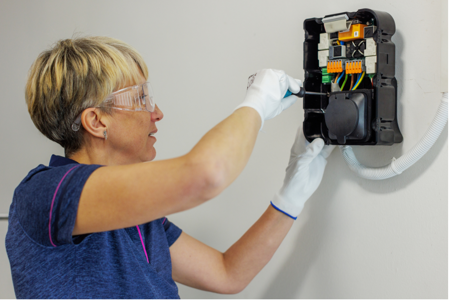
The increasing number of electric vehicles (EVs) in the ever-changing transportation environment of today represents a substantial movement towards sustainable mobility, which has led to a great deal of interest in EV/Tesla charger installation. An extensive EV charging infrastructure is needed to support this shift and accommodate the expanding fleet of EVs. As an informed EV owner, the first step to hassle-free charging is installing your EV charger wisely. Salutations and welcome to the all-inclusive manual of Princeton Electrical Makeover, your one-stop resource for better driving.
This article from Princeton Electrical Makeover explores various aspects of configuring Tesla and EV chargers, providing you with in-depth knowledge and professional guidance. We oversee every step of the installation process, from initial planning to continuing maintenance, to guarantee a smooth transition to electric vehicles.
Princeton Electrical Makeover is a leading supplier of electrical services and a supporter of green solutions. Our unmatched knowledge in installing EV/Tesla chargers is customized to your specific needs and preferences, maintaining our unwavering dedication to quality and innovation.
As your go-to partner for installing Tesla and EV chargers, Princeton Electrical Makeover will help you start this insightful journey. Let’s work together to create a more sustainable and green future one charge at a time.
Tesla/EV Charger Types
To ensure that the installation and design of your charging system are well-informed, it’s critical to understand the various charging levels for EV and Tesla chargers. To further understand each level’s traits and uses, let’s examine it in more detail:
1. Chargers for Level 1:
The most basic kind of EV chargers are called Level 1 chargers, and they usually use a regular household 120-volt AC outlet to charge. When purchasing an electric automobile, these chargers are usually included and are simple to install. Level 1 chargers add two to five miles of range per hour, which makes them convenient for overnight charging even though their charging rate is rather modest. Level 1 chargers work well for EV users who have little daily driving needs or have access to alternative charging options during the day because of their slower charging speed.
2. Battery Packs for Level 2:
Since Level 2 chargers can charge devices significantly faster than Level 1 chargers, installing them in homes and offices is advised. These chargers, depending on the battery capacity of the EV and the charger’s power output, can supply an EV with up to 60 miles per hour at higher voltages (often 240 volts AC). Because level 2 chargers may require the installation of specialist circuitry and electrical changes to accept higher power levels, these operations should be performed by a trained electrician. Level 2 chargers are more adaptable and practical than Level 1 ones, even though they require more installation money. For EV users with moderate to high daily driving needs, this is the best option.
3. DC Quick Chargers:
DC fast chargers, also known as level 3 chargers, are usually located at public charging stations close to major thoroughfares and roads. Their fast charging feature is built in. DC fast chargers deliver direct current (DC) electricity straight to the vehicle’s battery, circumventing the onboard charger, whereas Level 1 and Level 2 chargers convert grid power from AC to DC power to charge the EV’s battery. Charging may therefore proceed much more quickly. Certain DC fast chargers can improve range by over 100 miles in as little as 20 to 30 minutes. DC fast chargers are more expensive to construct and run, though, because they usually need certain infrastructure and equipment. They work best in scenarios that need for long-distance travel and quick charging, including fleet operations of commercial vehicles or public transportation.
It’s essential to comprehend the differences between Level 2 chargers, DC fast chargers, and Level 1 chargers in order to choose the charging option that best meets your requirements. Whether you need assistance with installation or professional advice for charging at home, the office, or on the go, Princeton Electrical Makeover can satisfy your needs.
Things to Think About Before Installing a Tesla or EV Charger
To guarantee optimal performance and safety, you should take into account a few important things before to installing a Tesla or EV charger. A closer look at the significant variables is provided below:
1. Assessment of the Configuration of the Home:
Check to see how well your house is wired for an EV charger before starting to install an EV or Tesla charger. This entails finding your electrical panel, confirming that there is enough electrical capacity available, and figuring out if adding circuitry made specifically for the charger is feasible. Consider speaking with a certified electrician to perform a comprehensive inspection and suggest any necessary modifications to meet the charger’s power requirements.
2. Electrical Power:
To choose the appropriate charger and guarantee compatibility with your current electrical setup, it is imperative to ascertain the electrical capacity of your home. It is crucial to consider elements like your electrical panel’s size, your electrical service’s amperage, and any appliances or electrical loads that might compete for electricity. Plan ahead for these possible expenses and practical challenges, since you might need to modify your electrical panel or service to accommodate the EV charger’s increased power demand. Take into account the long-term effects of higher energy use on your electricity expenses as well. Investigate ways to improve energy efficiency and cut costs by utilizing time-of-use pricing plans and intelligent charging choices.
By closely inspecting these parts and speaking with a licensed electrician, you can prepare the groundwork for many years of dependable and effective EV charging and ensure a simple and trouble-free installation process. At every stage, Princeton Electrical Makeover can help, providing knowledgeable guidance and expert installation services tailored to your unique requirements and preferences. Thanks to our knowledge and commitment to superior craftsmanship, you can be sure that your EV charger installation will be finished safely, effectively, and to the highest standards of perfection.
Setting Up for the Installation of EV/Tesla Chargers
There are a few essential measures you should follow to guarantee a seamless and efficient installation of an EV or Tesla charger. Here’s a closer look at the things you need to think about:
1. Assessing Electrical Capability:
You should assess your home’s electrical capacity to see if it can handle the charger’s power requirements before starting the installation. This entails determining the amperage rating and available circuit capacity of your electrical panel. Imagine your present electrical panel is unable to support the EV charger’s added load. If so, you might have to build special cabling or upgrade to a higher-amperage panel in order to accommodate the charger. It is strongly advised that you consult with a licensed electrician to thoroughly evaluate your electrical infrastructure and make any necessary repairs.
2. Getting the Required Licenses:
In order to assure compliance with building standards and laws, installing an EV charger usually requires obtaining consent from local authorities. Consult your local building department about the specific requirements for permits and the application process before beginning the installation process. Your electrician can help you get the permits you need and make sure everything is approved before installation starts. Following the legislation is essential during the installation process to avoid fines, delays, and other safety risks in the case that the necessary approvals are not obtained.
These safety measures along with close collaboration with a certified electrician, may guarantee high-quality Tesla charger installation. At every turn, Princeton Electrical Makeover is here to help. To make sure that your charging infrastructure is set up effectively, safely, and in compliance with all relevant laws, we offer knowledgeable advice and professional installation services. As we are dedicated to excellence and client happiness, you can rely on us to deliver outcomes that are both exceptional and fulfill your expectations.
How to Install a Tesla or EV Charger
To guarantee optimal performance and safety, there are a few important steps in the installation process for your Tesla or EV charger that need to be followed. This is a thorough explanation of what to anticipate from the installation:
1. Choosing a Trustworthy Electrician:
The first step in installing an EV or Tesla charger is to hire a professional electrician with experience installing EV chargers. Your electrician will inspect your electrical system to ensure that it complies with local building requirements and that the selected charger is compatible with it. To guarantee maximum performance and safety, they will also take care of the installation’s technical components, including wiring, circuits, and electrical connections.
2. Setting up a charger:
Once the electrical groundwork has been installed, the charger needs to be installed in the correct spot. This uses the proper bolts and hardware to fix the charger to a wall or mounting pedestal. The placement should minimize exposure to environmental risks such dampness, extremely high or low temperatures, and physical damage while facilitating simple access to charging. Your electrician will carefully install the charger in accordance with manufacturer specifications and safety precautions to maximize accessibility and aesthetics.
3. Attachments & Wiring:
After the charger is firmly secured, the electrician will integrate it with your home’s electrical system by installing the requisite wiring and making the necessary electrical connections. To guarantee safe and dependable operation, this entails extending the conduit or cable from the electrical panel to the charger position, making the appropriate terminations and splices, and confirming continuity and polarity. It is assured that adherence to best practices for insulation, strain relief, and wire routing will reduce the likelihood of electrical dangers and guarantee compliance with applicable electrical standards and regulations.
Employ a licensed electrician and follow industry standards for best practices. You can rely on the safest, most efficient, and best possible installation of your EV charger. Princeton Electrical Makeover is here to help you at every step. We offer professional advice and EV/Tesla charger installation services to make sure your infrastructure for charging meets and beyond your requirements. You can count on us to provide hassle-free, trustworthy, and specially designed EV charging solutions since we are dedicated to quality and client happiness.
Adopt Precautionary Measures
For the protection of people and property, it is essential to ensure the security of the EV charging infrastructure. This is a detailed examination of the safety precautions put in place:
1. Proper Grounding
Proper grounding is essential for the safe operation of EV chargers since it reduces the risk of electrical fires and shocks. Because electricians tie grounding rods or wires to the charger’s chassis, the charger is safely grounded to the earth during installation. By offering a low-resistance path for fault currents to safely dissipate, this grounding connection shields people and equipment from electrical risks.
2. Defense Against Overcurrent:
In order to protect EV chargers against overloads, electrical problems, and other overcurrent protection systems, circuit breakers and fuses are essential. Installed in the circuit that supplies power to the charger, these devices are intended to switch off the electricity in the event of a malfunction, such as an overcurrent or short circuit. When unanticipated operating conditions arise, overcurrent protection devices immediately turn off power to avoid overheating, electrical arcing, and other potentially hazardous scenarios. This improves the infrastructure for reliable and safe EV charging.
Here at Princeton Electrical Makeover, we prioritize safety in the design and construction of EV charging infrastructure. You can be sure that your EV charger is fitted with the highest care and attention to detail, guaranteeing a safe and dependable charging experience for years to come, because we strictly abide by industry best practices and regulatory standards.
Maintenance and Problem-Solving
For best results, regular maintenance is needed for the EV charger. This entails doing routine inspections and fixing typical problems such weak connections or damaged components.
Cost-related factors
The cost of installing an EV or Tesla charger may appear high initially, but there are long-term advantages, such as lower fuel and maintenance expenses.
Advantages of Proper Installation
Proper installation of an electric vehicle charger extends its lifespan, boosts charging effectiveness, and gives customers a sense of security.
Prospective Developments in EV/Tesla Charger Installation
There seems to be a promising future for EV charging because innovative solutions will further improve accessibility, efficiency, and convenience as technology develops. The following recent developments could influence upcoming EV charging advancements:
1. Wireless Charging Technology:
One of the most interesting upcoming technologies is wireless charging, which enables electric vehicles to charge by parking over a charging pad without any physical connections or interfaces. This creative solution removes the possible trip hazard connected with conventional charging cords and lessens the load on the equipment used for charging. How we charge our electric cars will change significantly as wireless charging technology advances and becomes widely used in commercial, home, and public settings.
2. The dual-directional charging capability
Bidirectional charging, which enables EVs to draw power from and return electricity to the grid as needed, is another new advancement in EV charging. With this two-way communication between EVs and the grid, there is a lot of potential for demand response, energy storage, and grid stabilization applications. Bidirectional charging creates new possibilities for energy optimization, peak demand reduction, and grid integration of renewable energy sources by utilizing the battery capacity of electric vehicles (EVs) as a flexible energy resource. Bidirectional charging technology adoption by utilities and regulators is anticipated to significantly impact future energy management and system resilience.
Princeton Electrical Makeover is dedicated to offering state-of-the-art solutions that satisfy our clients’ changing needs. We will remain at the forefront of the EV/Tesla charger installation revolution as these and other breakthroughs come to fruition. We are uniquely positioned to spearhead the transition to an EV charging environment that is more intelligent, environmentally friendly, and sustainable than ever before, thanks to our progressive thinking and commitment to innovation. Come along with us as we clear the path for a future that runs on electricity and is brighter, cleaner, and more productive.
Impacts on the Environment
Transitioning to electric vehicles and investing in EV charging infrastructure will drastically reduce carbon emissions and encourage ecologically friendly transportation options.
Usability and Interface
Advances in convenience and user experience are revolutionizing the way EV owners interact with their charging infrastructure, making the switch to electric transportation simpler and more natural than ever. Below is a closer look at some of the advancements that are causing this shift:
1. Combining Integration with Smart Home Systems:
Integrating smart home technologies and charging infrastructure is one of the biggest developments in EV charging. Owners of electric cars can improve energy efficiency, save utility expenses, and take advantage of off-peak electricity rates by timing their charging to coincide with smart thermostats and energy management systems. Thanks to this seamless connectivity, users now have more freedom and control over the charging process, enabling them to customize their charging experiences to fit their particular tastes and lifestyles.
2. Features that make something accessible:
An increasing amount of focus is being placed on creating charging infrastructure that is accessible to all users, including those with disabilities or mobility issues, as the number of people using electric vehicles rises. This includes attributes like auditory signs, tactile indicators, and user-friendly interfaces that enable people with diverse needs to use EV chargers and navigate independently. Regardless of ability or physical restrictions, we can guarantee that everyone has access to electric mobility by giving inclusivity and accessibility a priority when designing EV charging infrastructure.
Princeton Electrical Makeover is dedicated to providing innovative, easily obtainable, and intuitive EV charging options. We can provide our services to a larger audience because of these developments in ease and user experience. Our goal is to redefine the EV charging experience and enable people to easily and comfortably transition to electric mobility by prioritizing the needs and preferences of our consumers. Come along with us as we push the boundaries of quality and innovation in EV charging systems, paving the way for the widespread use of electric vehicles.
Conclusion
Finally, installing your EV/Tesla charger carefully is the first step towards a faultless installation. To guarantee optimum performance and safety, every step—from determining the charger’s electrical capability to mounting it and finishing the required electrical connections—is required. In order to facilitate your transition, Princeton Electrical Makeover understands how critical it is to have a reliable infrastructure for charging electric vehicles.
When it comes to installing EV chargers with unmatched professionalism and skill, Princeton Electrical Makeover is the trustworthy partner you can rely on to enhance your driving experience. Our team of skilled electricians and our dedication to offering excellent service combine to create a simple installation procedure that caters to your unique requirements and preferences.
Great service and peace of mind are yours when you hire Princeton Electrical Makeover to install your EV or Tesla charger. Our commitment to excellence and client happiness makes us the ideal choice for installing Tesla and EV chargers. Princeton Electrical Makeover offers a unique experience. Drive your EV adventure with assurance.
Are you prepared to switch to simpler EV charging? To find out why Princeton Electrical Makeover is the go-to company for EV charger installation, call us at (609) 834-5524. Allow us to assist you in switching to electric cars so you may enjoy environmentally friendly transportation.
Frequently Asked Questions
1. Can I set up an EV charger on my own?
While some people are able to complete the installation on their own, it is advisable to work with a trained electrician to guarantee both safety and legal compliance.
2. How much does it cost to install an electric car charger?
Several hundred to several thousand dollars may be spent on installation, based on variables including location, kind of charger, and electrical configuration.
3. Are there any government grants available to install EV chargers?
In fact, a lot of nations provide incentives—like tax breaks or refunds—to promote the development of EV charging stations.
4. How long does an EV charger last?
EV chargers can survive for many years, almost as long as the car itself, assuming they are maintained properly.
5. Can a non-Tesla charger be used to charge a Tesla?
Although Tesla’s Supercharger network offers quicker charging speeds, Tesla vehicles can still be charged using non-Tesla stations.
The post EV/Tesla Charger Installation, The Complete Guide appeared first on Princeton Electrical Makeover.